

You may have been valuing bitcoin all wrong.
In my video on how to value bitcoin, I asked what one bitcoin might be worth ten years from now. To account for both the risk of failure and the potential upside, I used four hypothetical prices ranging from zero to $1.14 million in today's dollars. I gave each price a probability for the example, then averaged the prices with more weight on the likelier outcomes. That works out to about $502,000 per bitcoin. The animation shows how much each outcome contributes to that average.
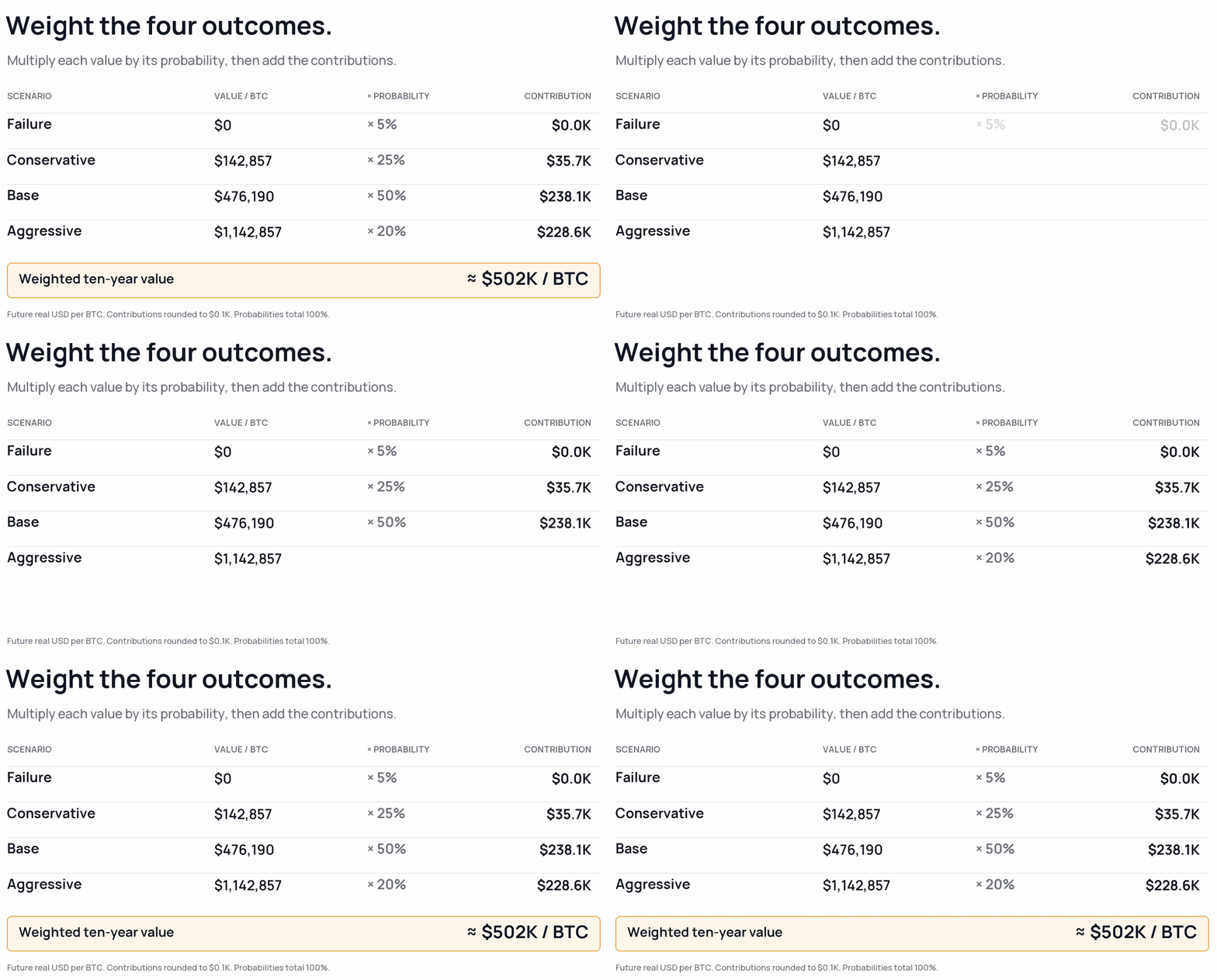
If you're using bitcoin to fund retirement, you still have to put a growth rate into the FIRE BTC Compass and decide how much you can spend. I'd start with a withdrawal amount I expect to hold up across a range of returns.
🃏 What the $502,000 Average Leaves Out
In Issue #29, I used poker to explain expected value. You can make a good bet given the odds and the payoff and still lose the hand. I can use the same reasoning to decide whether bitcoin is worth buying at a given price. When I'm setting a retirement budget, I care about whether my savings can cover the bills for the full retirement.
Starting at $80,000, bitcoin would have to grow about 6% a year after inflation to reach the conservative price in ten years, 19.5% to reach the base case, and 30.5% to reach the aggressive case. Getting to the weighted average would take about 20.2% a year.
The aggressive case pulls the average above the base case, and the three outcomes below $502,000 add up to 80% of the odds in this example. The failure and conservative cases alone account for 30%.
Those odds describe where bitcoin ends up in ten years. To test a withdrawal rate, the Trinity study followed portfolios year by year. In one test, a portfolio split evenly between stocks and bonds started with a 4% withdrawal. With the dollar amount adjusted for inflation each year, the portfolio lasted 30 years in 95% of the historical periods. The original Trinity study
I'll use the conservative case to stress-test an 8% starting withdrawal from bitcoin.
