

Last week, Finance Guy shared a Graham Stephan video about paying off low-interest mortgages and declared that living debt-free is the best way to live.
I quote-posted it with a fairly unambiguous response:
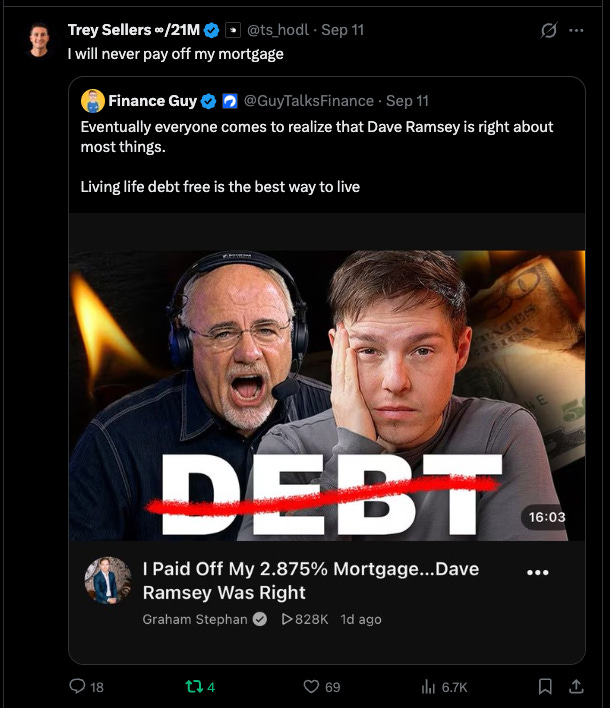
Graham's experience deserves a little context. He sold three properties and repaid their mortgages, including loans as cheap as 2.875%. He described feeling relieved afterward, even while acknowledging the financial case for keeping cheap debt. Selling rental properties also removes the work and obligations that come with owning them, so his experience involves more than paying off a loan while keeping the same house.
My preference is to keep mortgage debt, assuming rates remain at historical norms or lower, because it lets me hold more liquid assets that I expect to grow faster than the cost of borrowing. Having those assets available gives me peace of mind.
I've written about that before in Peace of Mind, but my second quote-post put two people through the comparison: Paydown Paul and Investing Ian.
They buy the same house, take the same mortgage, and commit the same amount every month. One becomes mortgage-free much sooner. The other keeps investing.
Let's follow their money, including what happens when the investment returns disappoint or life interrupts their income.
🏠 Two houses, one choice
Paul and Ian each buy a $500,000 house with 20% down. That leaves a $400,000 mortgage, fixed for 30 years at 7%, with a monthly principal-and-interest payment of $2,661.21.
That's close to the 6.76% national average reported for a 30-year fixed mortgage on September 10. We're keeping 7% so the example follows my original post.
A mortgage can make buying possible years before you could save the entire purchase price. Whether to buy now or wait, and whether to buy or rent at all, are separate questions. Paul and Ian have already decided to own.
Each has another $1,000 available every month. Paul sends his to principal. Ian invests his in the S&P 500, assuming a 10% annual return with dividends reinvested.
Paul pays off his mortgage in 14 years and 7 months. From then on, he invests the entire freed payment plus the extra $1,000—about $3,661 a month. He also invests the unused portion of his budget in the final payoff month.
Ian keeps making his scheduled mortgage payment and investing $1,000 a month for all 30 years.
Both commit the same $3,661.21 each month to their mortgage and investments. Taxes, insurance, and maintenance are additional household expenses shared by both; paying off the mortgage doesn't eliminate them.
Once Paul pays off his mortgage, he invests $3,661 a month to Ian’s $1,000. Can those larger contributions make up for almost fifteen years of missed compounding?
