Bitcoin is down roughly 40% from its all-time high. If you've been stacking toward a FIRE number, you're watching a chunk of your progress evaporate in real time. That's the reality of holding an asset with 75-85% historical drawdowns. The question is whether your FIRE plan can survive one.
You've stacked for years, hit your number, and you're ready to walk away from the paycheck. And then bitcoin drops 50%, then 70%, then 80%. You still need to pay your mortgage, feed your family, keep the lights on. So you sell at the worst possible time because you have no other choice.
I've written about the 4% rule and bitcoin before and how to calculate your stacking goal. Those pieces gave you the means to calculate a target portfolio size. This one gives you the plan for when the market tests your resolve. Conviction matters, and I wrote about that when it got tested earlier this year. But conviction is an ongoing test, not a box you check once. You need structure behind it.
🧱 The 4% Rule — Quick Refresher
The Trinity Study (1998) backtested retirement portfolios from 1926 to 1995. A balanced portfolio of stocks and bonds, withdrawing 4% in year one and adjusting for inflation after, survived 30 years in 95% of historical start dates. It became the default FIRE formula: multiply your annual expenses by 25, and that's the portfolio size you need to hit to retire.
The 5% of scenarios where it failed are worth understanding. They were driven by sequence-of-returns risk: retiring right before a major downturn. For example, the late 1960s and early 1970s brought stagflation, oil crises, and a decade of miserable returns. If you started withdrawing during that window, you may have run out of money in your retirement.
Big ERN at Early Retirement Now has the definitive deep dive, a 60-part series with over 6.5 million simulated withdrawal rates. His take: prescribing one withdrawal rate for everyone is "about as ludicrous as suggesting that we should all wear size 10 shoes." For early retirees with 50+ year horizons, 4% might be too aggressive. For retirees with pensions and Social Security coming, too conservative.
The 4% rule is a useful starting point, not a guarantee. And it was built for a portfolio of stocks and bonds that doesn't look anything like what most of us hold. (For the fundamentals, see FIRE Fundamentals.)
₿ A Different Playbook
Bitcoin's drawdowns make stocks look tame. The S&P 500 dropped about 55% during the 2008 financial crisis and roughly 86% during the Great Depression. However, bitcoin has routinely dropped 75-85% over its short-ish history. The 2017 cycle brought an 80% crash that took three years to recover, and the 2021 cycle dropped 76% over 28 months.
The other factor is how you fund withdrawals. With a stock portfolio, dividends cover part of your spending automatically. With bitcoin, every dollar you need means selling. I've argued before that dividends are overrated as an investing thesis — a company paying dividends is really just forcing you to take cash out of the business — and I still believe that. But when you're modeling withdrawal rates, the math cares about whether you're selling units of the asset or not, regardless of the philosophical debate.
And we're working with 15 years of history instead of 100. We can't run the same exhaustive backtests. We're applying similar methodology with informed growth assumptions (reasonable, I believe) but we should be honest about the difference.
On the other side of the ledger, bitcoin's expected returns blow stocks out of the water. I use a conservative 25% annualized growth estimate, compared to 10% for stocks. That growth rate is what makes the Goalseek framework work: the withdrawal rate model from Issue #59 that backs into your BTC target number based on expected asset returns. It implies an 8% withdrawal rate for the bitcoin portion, double the traditional 4%.
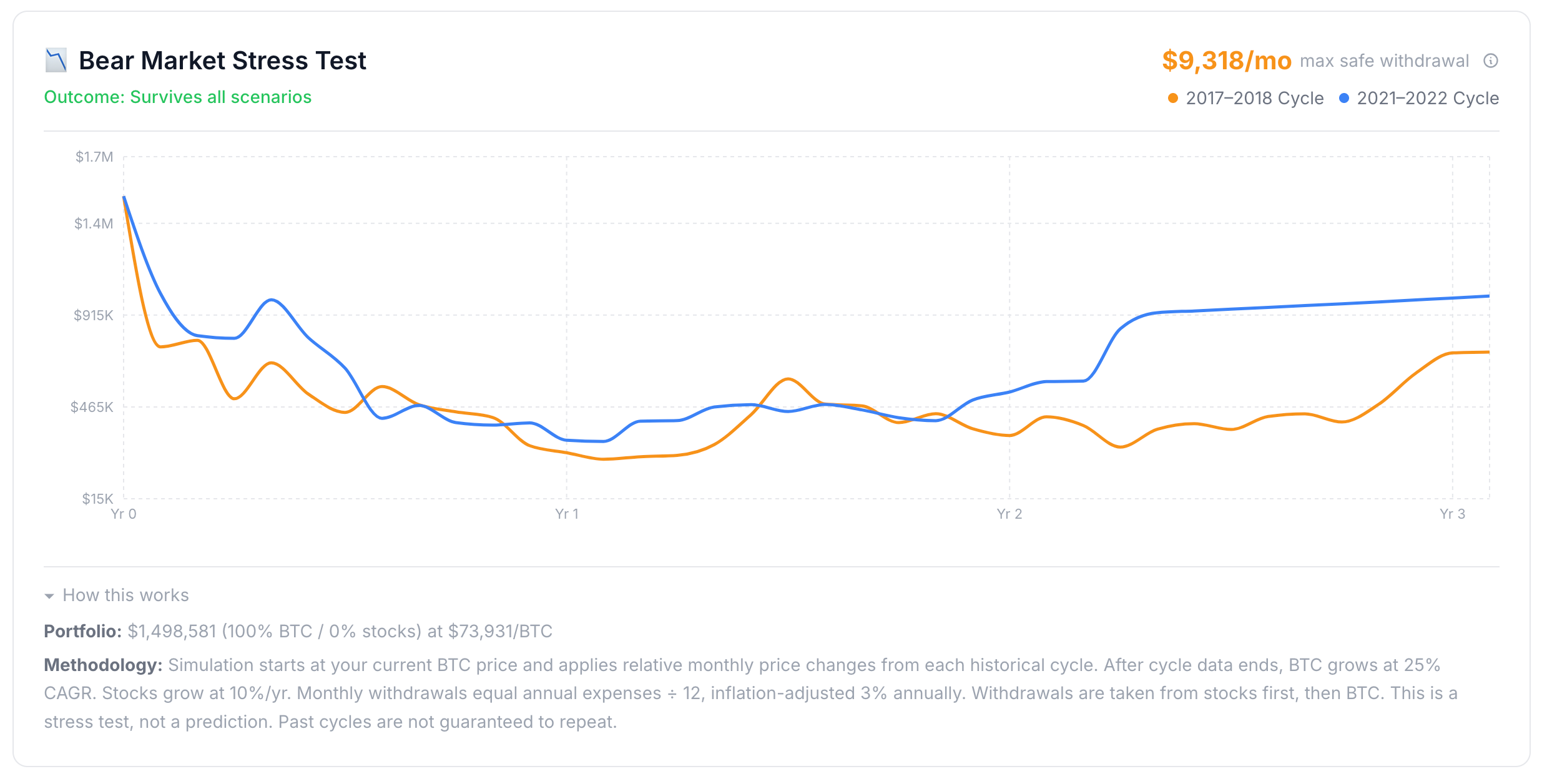
Bigger upside, bigger downside. The strategy needs to account for both, and I just shipped a new Bear Market Stress Test in the FIRE BTC Compass that does exactly that.
📊 Stress Testing Your Portfolio
I ran four scenarios through the new Bear Market Stress Test in the Compass. The assumptions: a $1.5 million starting portfolio at today's prices (BTC at ~$74,000), $100,000 per year in expenses, and the only variable being how that $1.5 million is split between bitcoin and stocks.