

I got back from Strategy World in Vegas a couple of weeks ago. The conference covered a lot of ground — Saylor’s vision for bitcoin-backed capital markets, corporate treasury strategy, how they see the next decade playing out. But the instrument that Strategy’s team was clearly most excited to push was their preferred stock, STRC.
If you told me a year ago that I’d be writing enthusiastically about a dividend-paying instrument, I would have pointed you to Coal in Your Stocking, where I made the case that dividends are a drag on wealth building. The “dividend bros” are still wrong about that, by the way.
But STRC isn’t a dividend stock. It’s something structurally different — and it deserves a hard look from anyone on the FIRE path.
⚡ FIRE BTC covers bitcoin through the lens of financial independence — the strategies, the math, and the mindset shifts that most finance writers miss. If you’re not subscribed yet, join us. If you’re already here, consider upgrading to paid to support the work and unlock the full archive.
🔍 What Is STRC?
STRC — “Stretch” — is a perpetual preferred stock issued by Strategy (formerly MicroStrategy). Here’s the short version:
Variable dividend, currently at 11.50% annualized
Paid monthly, based on a $100 par value
Return of capital tax treatment (more on this — it’s a big deal)
Not convertible into common stock
Backed by a company sitting on 738,731 bitcoin
Michael Saylor described it on Natalie Brunell’s podcast with a line that stuck with me: “Would you like a bank account that pays you 11% that’s tax deferred? STRC. That was a thousand hours of engineering. This is ten seconds to explain.”
He’s not wrong about the simplicity. But the “thousand hours of engineering” part matters too, and that’s what I want to unpack through a FIRE lens.
🤔 Why I Care About This
So why am I now talking about a yield instrument after writing an entire issue of the newsletter about why dividend investing is sub-optimal?
Three reasons.
The yield is structurally different. STRC dividends are classified as return of capital, which means they aren’t taxed as ordinary income or qualified dividends. You aren’t taxed when you receive them. Instead, your cost basis goes down. Tax is deferred until you sell, and if you hold until death, your heirs get a stepped-up basis.
To put it concretely: a qualified dividend taxed at 15% turns an 11.5% yield into 9.8% after tax. An ordinary income dividend at a 32% marginal rate nets you 7.8%. STRC nets you the full 11.5% until you sell. That’s a meaningful edge for the same headline rate.
The backing is bitcoin. Strategy holds over 738,000 bitcoin. At current prices, that’s north of $60 billion backing roughly $13.6 billion in total obligations. The BTC Rating — their overcollateralization metric — sits at 4.5x. STRC isn’t a corporate bond backed by a chain of Applebees. The primary asset underneath it is the hardest money ever created. If you believe in the staying power and growth potential of bitcoin, that should go a long way toward understanding why STRC is promising.
The volatility profile is manageable. STRC launched around $88 and quickly moved toward par, with only brief dips (to around $90 as the lowest) before recovering. And if you look at the chart, the volatility appears to be dampening over time.
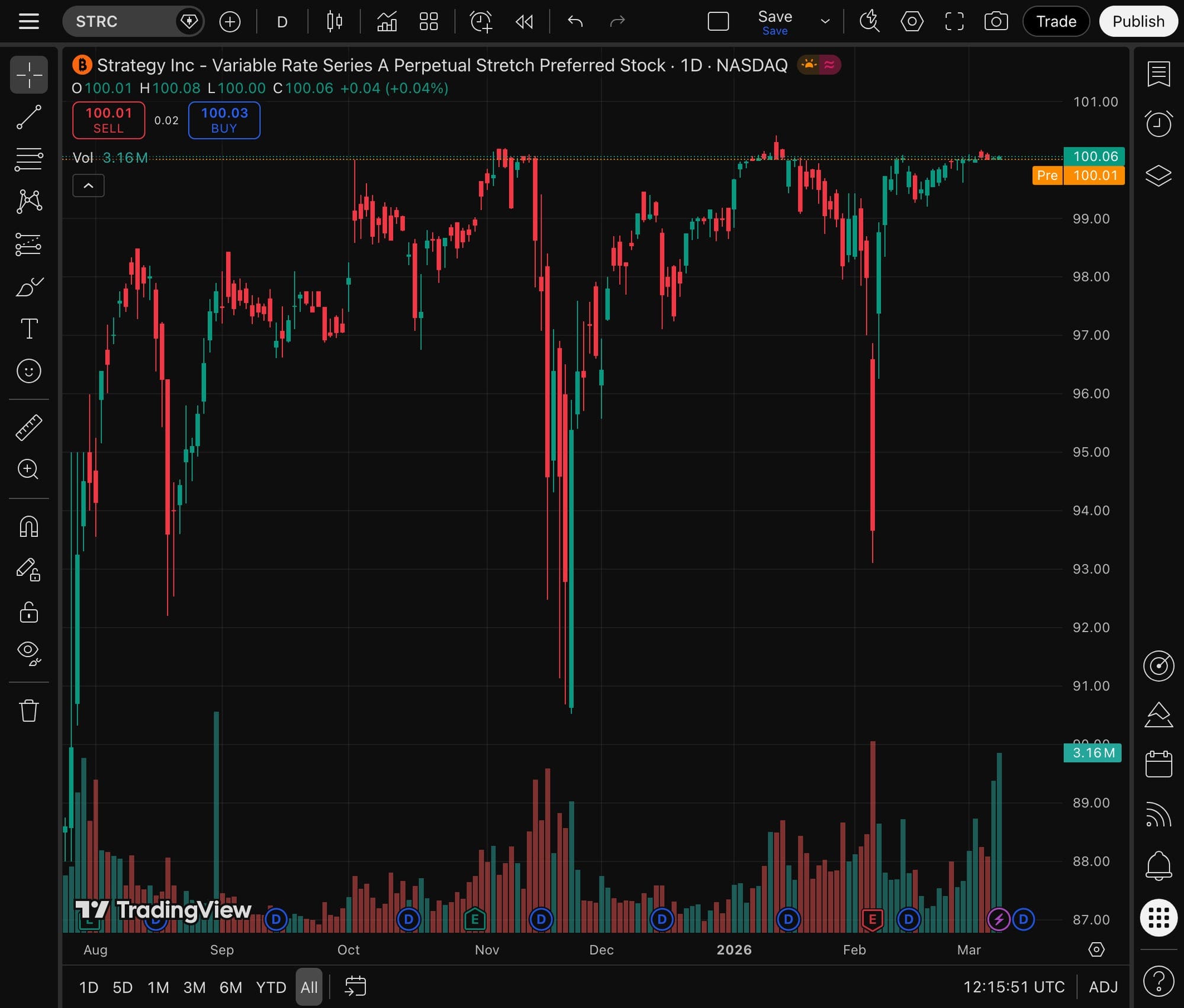
Saylor has pointed out that STRC’s volatility is lower than both the Nasdaq and the S&P. For someone building a FIRE portfolio, that kind of stability in a yield instrument is meaningful.
🔢 The FIRE Math
The traditional 4% rule says you need 25x your annual expenses saved to retire. If you spend $80,000 a year, your target is $2 million.
What if part of your portfolio is throwing off 11.5%?
A $400,000 position in STRC generates roughly $46,000 per year — enough to cover more than half of that $80K spend. And because it’s return of capital, it doesn’t push you into a higher tax bracket.
Another way to think about it: to generate $40,000 in annual income, you need $1 million in index funds (at 4%) or about $348,000 in STRC (at 11.5%). That’s 65% less capital required.
But the bigger point here is the comparison to your stock allocation. If you’re holding index funds that have historically returned around 10% annually with significant volatility — 20-30% drawdowns in bad years — why wouldn’t you prefer an instrument returning 11.5% with a fraction of that volatility and tax-advantaged treatment on top? All other things equal, a 10%+ return with minimal volatility beats a 10% return with stock-market-level volatility every time. For FIRE practitioners, the reduced sequence-of-returns risk alone is worth considering.
I’m not saying dump your index funds and go all-in on STRC. But as a tool in the FIRE toolkit — particularly for bridging early retirement expenses while your bitcoin stack appreciates — the numbers are hard to ignore.
⚔️ The Carry Trade: Real Numbers
In Speculative Attack, I wrote about borrowing in a weak currency to invest in a stronger one. Using debt strategically to accelerate FIRE — the Aikido finance approach.
So what does a speculative attack look like with STRC?
This is something I’ve done personally. I’m not going to share my specific dollar amounts, but I can illustrate the approach using my actual economics — the same entry price, the same rates, the same timeline — with a $50,000 example to make the math tangible.
