

A comment on X got me looking at how the FIRE BTC Compass counted rental income.
Continuing rental income reduces how much you need to withdraw from investments to cover your retirement expenses. If you expect to spend $100,000 a year, the usual 4% calculation gives you a $2.5 million investment-portfolio target, because it assumes your investments have to pay the full $100,000.
Now say you already own a rental property that brings in $20,000 a year after all property expenses, available for you to spend. Your liquid portfolio investments only need to cover the remaining $80,000. At 4%, that's a $2 million target.
I wouldn't buy a rental property just to shrink my FIRE target. I think most people have an easier path with index funds and, for me, bitcoin. Owning rentals is a business. But if you've already built one that pays you dependable income, it should count.
That's why I added a way to include continuing income in the Compass. You can see how much it reduces your target, then consider income that arrives later, like Social Security. Those future benefits can also cover part of your expenses, but your investments have to fund the years before the payments begin.
🏘️ Let the rent count
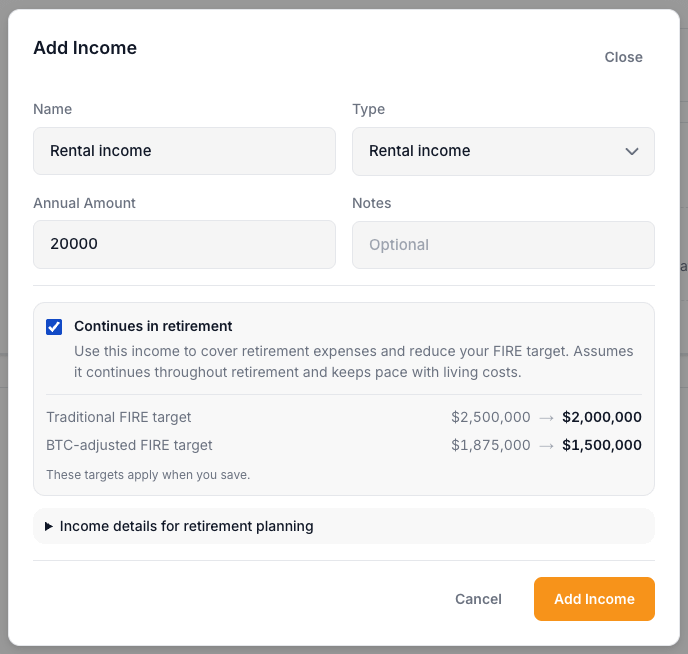
To include rental income in your target, the Compass needs to know that you'll still receive it after you stop working. We're counting the $20,000 as net income available to spend and assuming it keeps pace with living costs, so it continues covering that share of your $100,000 budget.
In the Compass, go to My Finances → Income, add or edit an income source, and select Continues in retirement. You'll see how the income changes your FIRE target before you save it.
This is available for free in the Compass tool. You can use it for rent, a pension, or Social Security you're already receiving and expect to keep receiving. Continues in retirement assumes the income starts when you retire and keeps coming. There isn't yet a field for income that begins later, but keep an eye out because I'll be building that soon.
Social Security follows the same idea as real estate investment income: it pays part of your expenses, leaving less for your investments to cover. The difference for an early retiree is timing, because benefits may start years after you stop working.
I'm 42. Suppose I stopped working now and claimed benefits at 67. With an illustrative $100,000 annual spending budget and $30,000 annual benefit, my investments would need to cover the full $100,000 for 25 years, then $70,000 a year after benefits began. What does that 25-year wait mean for the amount I'd need to save before stopping work?
